- Bentonville Roots and Fruits
- Posts
- A 24-year-old farmer is reinventing the way Northwest Arkansas thinks about its vegetables—and what it means to be successful
A 24-year-old farmer is reinventing the way Northwest Arkansas thinks about its vegetables—and what it means to be successful
Jeremy Baranauskas is living out his life’s passion, and he’s become one of the region’s most iconic farmers in the process.

Jessica Mathews
January 11, 2026
It’s a Thursday afternoon, and the sun is blazing down on us as Jeremy Baranauskas, a farmer in Sulphur Springs, Arkansas, gently tugs a purple onion out of the dirt and turns it over in his hands.
He carefully pulls away the outer, dirty layer, revealing a royal purple, shiny bulb, and holds it up so I can see it.
It’s too small, he tells me. Jeremy hadn’t covered the plot with the black tarp before transplanting the onions, and pests had laid eggs in the soil. Now they had been feasting.
It was a big mistake, he says. But about seven years into running his own farm, he thinks this was his last big mistake.

Jeremy points out an onion that is two sizes too small.
Photo by Jessica Mathews
Jeremy, 24, runs one of only 137 certified organic crop farms in the state of Arkansas—and he is one of only two organic farmers in Benton County, according to the United States Department of Agriculture. In 2019, he and his parents moved from Geneva, Illinois, a small town a 30-minute drive outside of Chicago and bought this 25-acre plot of land out in Sulphur Springs. Jeremy started planting seeds immediately, and at his first farmer’s market in 2019, was selling squash and zucchini. Now, PrairieWoods Farm reports to be in the top 5% of sales at the farmer’s market, and it takes up two booth spaces. Jeremy sells everything from basil and parsley to garlic and eggplant to arugula and spinach, turnips and parsnip, tomatoes and potatoes, and sometimes even fun exceptions like sunflowers. You can find PrairieWoods Farm produce at the Co-Op in Fayetteville, or in dishes at Matt Cooper’s Bentonville restaurants Conifer and Ryn. The University of Arkansas and the local culinary school, Brightwater, collaborated with him, using peppers Jeremy had flash frozen for 6 months, so students could process and create pepper sauce for a competition. And you better show up early to his stand at the farmer’s market, because by the end of the day, his vegetable-filled wooden crates and bins are often totally empty.
“It can’t grow any more. It’s against the rules,” Jeremy’s mom, Tracy Baranauskas, jokes about the farm as we sit at a table outside the barn.
I first met Jeremy about five years ago. A friend of mine was traveling for work and had me go pick up her weekly CSA at the farmer’s market—back when Jeremy still offered those. I went home with a huge bag of vegetables and got cooking, tossing a bunch of PrairieWoods carrots on the grill with a soy garlic glaze sauce I made. Ask anyone—I’ve been hooked on these veggies ever since.
But it wasn’t until last winter, during the farmer’s market off-season when I went to go pick up my vegetables in person out on the farm, that I fully began to appreciate just what Jeremy has built—and the thought, time, money, and sacrifice that’s gone into growing the poblanos and tomatoes I can’t get enough of. In an age where we can push a button and have our groceries delivered to our doorstep in two hours, neatly packaged and sometimes devoid of their original form, many Americans have found themselves entirely removed from the people who grow their food and from the daily battles of pests, rain, storms, and heat that consume so much of an organic farmer’s existence.
But you can’t forget any of that when you’re following Jeremy through the rows of crops and inside the covered tunnels at his farm, sweat beading up and trickling down your neck. This is Jeremy’s whole life, thoughtfully planned out and carefully tended to. This is where he spends every day—and most waking hours. And as he tells you about it, you come to understand that he does it for no other reason than that he absolutely adores it.

Jeremy spends seven days a week on his farm and in his covered tunnels and greenhouses.
Photo by Jessica Mathews
FARMER’S HANDS
To understand Jeremy Baranauskas, you must first notice his hands. They’re dirty—caked in soil and earth that has found its way under his fingernails and in the crevices of his palms. There are scars that trace up his arms.
This is his proof. If there were synthetic fertilizers and pesticides used at PrairieWoods Farm—the man-made chemicals the vast majority of farms in the U.S. rely upon to help ease the growing process—then Jeremy would need protective gloves and gear when fertilizing his crops out in the greenhouses and out on the land. But he doesn’t wear any of that. There’s just the marriage of dirt and bare skin. There’s just his hands.

Jeremy shows off the vibrant purple meat of a potato he has split in half with a knife.
Photo by Jessica Mathews
It was an easy decision for him, he says, to take this path. When he was a freshman in high school, his first and only job was working on a commercial farm in Illinois, helping them grow and harvest fruits and vegetables like corn and watermelon. But he quickly became disturbed at some of the safety precautions they had to take, and the gear he had to wear, when adding fertilizers or spraying the crops with pesticides.
“Why would I want to eat something that has this [chemical] on it that I'm not supposed to touch at a concentrated ratio?” Jeremy asks me. “It just seemed weird that I couldn't go out in the field and just pick tomatoes and start eating them, because the boss would come out and say: You're going to get sick. You have to wash them before you eat it, because we just sprayed it with copper fungicide three days ago and that doesn't come off in the sun.”
While organic veggies are becoming more and more popular amid growing research that links serious health effects to consumption of these chemicals, more than 99% of U.S. farmland is still fertilized with commercial, synthetic fertilizers, according to the latest available data from the Census of Agriculture, which was conducted in 2022. Only 5% of all U.S. farms are using organic fertilizers, according to that data. There are obvious reasons why. Synthetic fertilizers provide nutrients to the soil in a form that’s immediately available to plants and also manufactured to precise specifications, making your crop and output consistent and predictable. And synthetic pesticides are incredibly effective at keeping bugs and pests away—some of the biggest threats to a farm. You can spray tomatoes once, and protect them from bugs the rest of the season. From a pure business standpoint, using man-made chemicals makes a lot of sense.
But your mom always told you to wash the vegetables before you chop them up for a reason, too, and that’s because those chemicals don’t just go away on their own. Research shows that synthetic fertilizers have degraded soils and can increase heavy metal levels in plants. While it’s an ongoing area of study, synthetic fertilizers and pesticides are also being linked to cancer like leukemia and lymphoma, or neurological diseases like Alzheimer’s.
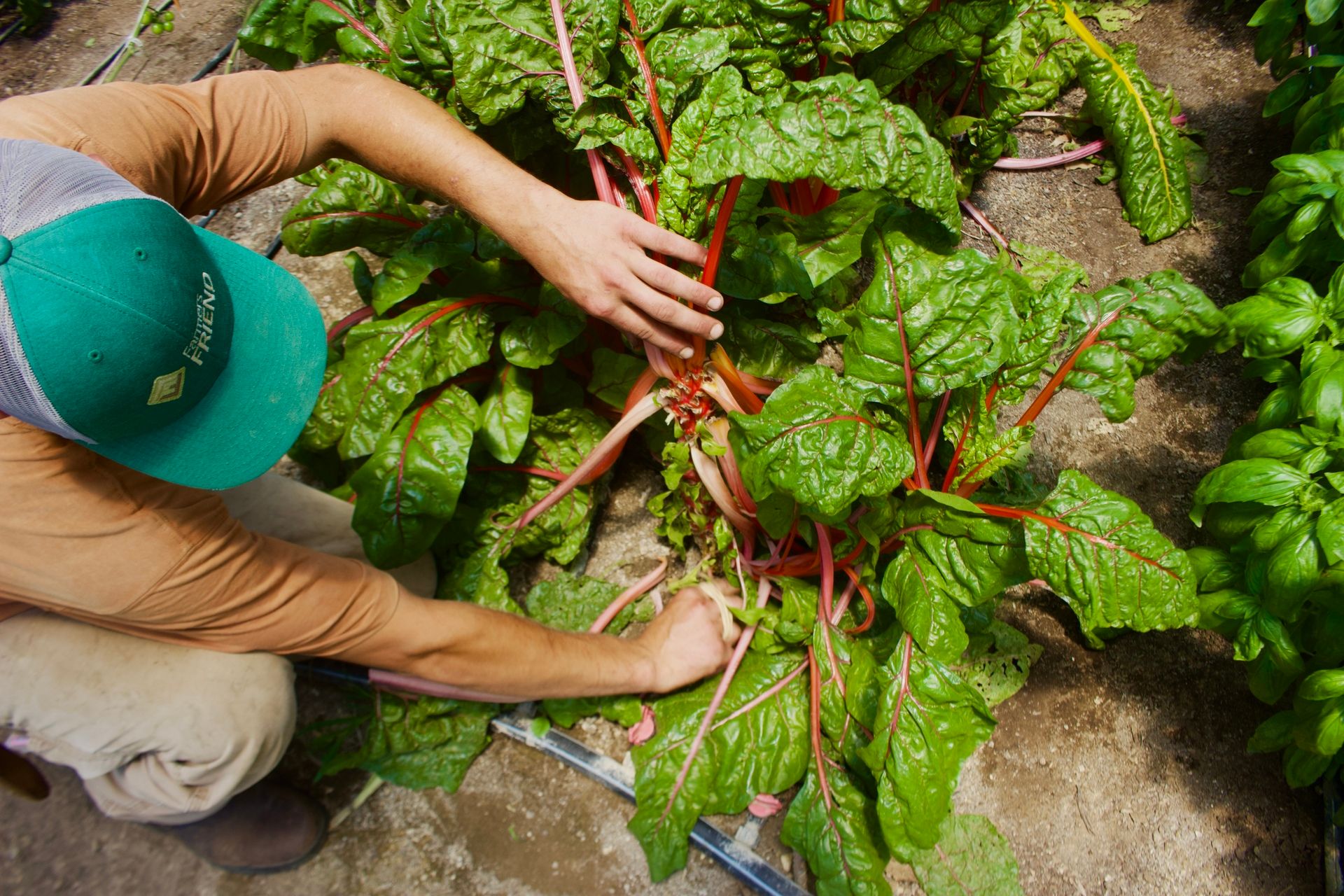
Jeremy pulls the leaves away from the swiss chard plant growing in one of the caterpillar tunnels.
Photo by Jessica Mathews
But that’s the risk to the consumer, the person shopping at the grocery. As Jeremy and I talk, he points out the serious health implications these chemicals pose particularly to the laborers—the people working out on the land day to day. Even with protective gear, it’s these people who are at much higher risk because of concentration and repeated exposure.
“The people that are spraying the vegetables and using the chemicals and are coming in contact with them are the people that are now having these autoimmune disabilities and forming these weird diseases and these weird health issues, and it's just being transmitted on now to further generations,” Jeremy says.
Who, then, is most affected? Seven out of 10 farm workers in the U.S. are Hispanic, according to 2025 data from the health policy organization KFF. Fewer than half of farm workers have any kind of health insurance, that same research report shows.
Jeremy knew immediately he wanted to do things differently—even if it was harder. He remembers spending all his study halls junior and senior year watching farming videos on YouTube—teaching himself organic farming methods and how growing organic protects the environment through better soil health and lower emissions, and how it promotes animal welfare. The same month he graduated high school in 2019, Jeremy and his family drove down to Arkansas on a 25-acre piece of land they had purchased with nothing on it. Jeremy got to work in the baking heat of the Arkansas sun, and he started farming.
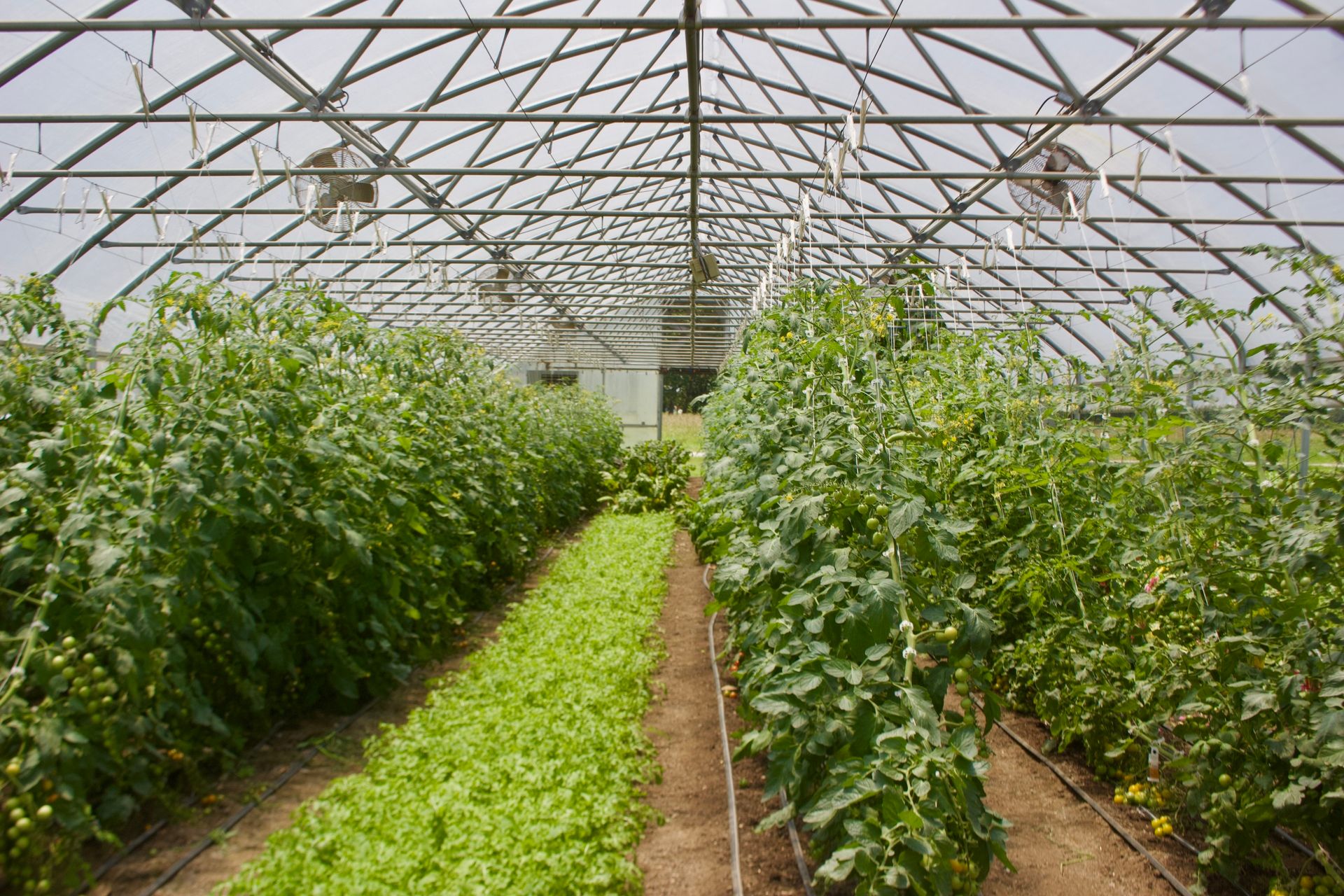
More than 99% of U.S. farmland is fertilized with man-made, or synthetic, chemicals, according to the latest available data from the Census of Agriculture.
Photo by Jessica Mathews
A FAMILY AFFAIR
If you have stopped by the PrairieWoods booth at the farmer’s market on Saturdays, you know Tracy. If you don’t yet know her by name, you’d recognize her by her smile or the way her face lights up when she talks to you—like there isn’t a line of people waiting to pay for carrots and potatoes right behind you.
Tracy has a knack for people. Where Jeremy can be quiet, his mother is bubbly and energetic, making recommendations on how to use those veggies—stems, leaves, and all—and greeting babies and pups who have tagged along for the day.
What you may not know about Tracy is that she is a volunteer. Tracy is out helping her son on the farm just about every day of the week. She does it to make sure that their family has the time to give back to the local community.
“I look at it like this,” Tracy says. “[Jeremy] doesn’t have time to stock the food pantry refrigerators, and that is my get-up-and-go-moment, because I really want to close the gap on not just food insecurity, but local produce, organic produce.”
Tracy says it was Jeremy’s obsession with organic growing methods that lit up something inside of her, too. “I would never, ever want to eat non-organic,” she says. And it was important to her that the people in her community—whether they could afford it or not—had the same option that she does when they’re shopping at the local food pantry.
In 2024, PrairieWoods Farm donated 4,000 pounds of produce over 32 weeks, Tracy says, primarily via the food pantries Seeds that Feed, which has 24/7 refrigerators that operate off an honor system. PrairieWoods Farm also stocks a local food pantry in Sulphur Springs, she says.
“That's only because I come in and I take the reins with that, because there just would not be enough time of the day to get all that done,” she says.

From left to right: Jeremiah, Jeremy, Tracy, and their dog Roscoe.
Photo by Jessica Mathews
As we are talking, Jeremy’s father, Jeremiah, comes home from work and comes out to the barn. Jeremiah will often come and help out on the farm after he gets home from tool-making, and help water, seed, and harvest.
When the Baranauskas family first moved to Arkansas, it was difficult. While they were building the home that now sits on the property, Jeremy says they would sleep in their car sometimes those first couple months until they eventually found a rental place in Hiwassee, Arkansas, about a 30-minute drive away. For the first 2.5 years before their home was finished, Jeremy would spend all day out in the hot summer heat, getting the farm going. He purchased a little plastic canopy from Lowe’s and set up a table and chair underneath it to get out of the heat.
“Our neighbor that sold us the land would come over here with her golf cart and bring him lunch, dinner, and drinks, and make sure he was still alive,” Tracy says.
As time went by, the farm grew, and Jeremy started selling new produce, expanding his booth at the farmer’s market, and working with some of the local restaurants. They constructed a barn across from the farm, and later built the washing and pack room and cold storage room with help from a grant via a pilot program funded by the Walton Family Foundation. There are now nine caterpillar tunnels, each filled with rows of produce like tomatoes, dill, cabbage, and collard greens. There is also a propagation tunnel and a greenhouse on the property.

Isaac Sullivan, who worked as a farmhand at PrairieWoods Farm in 2025, pulls a cart across the farm.
Photo by Jessica Mathews
Jeremy says he’s getting the hang of things now—and he’s able to start focusing on perfection. This past year was the best one yet for cauliflower, he says. He learned to harvest them within two days, so they didn’t turn brown. And he folded their leaves over as they got bigger—shaping the leaves into a little dome—to keep the sun off and keep them pure white.
“I’m looking back at five years and being like: Okay, this is good. We actually did this at this time, and it turned out really well. We're having a lot of success,” he says.
NO DAYS OFF
When I asked Jeremy how many days he’s taken off since buying this piece of land, he didn’t need long to calculate it in his head.
There were the four days he spent in the hospital, he says, after he hurt his elbow. He had to miss the farmer’s market that week. And then there was last winter, when he attended a three-day gathering for local farmers in an Airbnb out on Table Rock Lake.
When I asked if he had ever taken a day off simply to take a break or go into town, try a new restaurant, travel, he was quick to say: “Not on purpose.”
“If it's summer, you have tomatoes, cucumbers, zucchini, squash, sometimes peppers, okra, that has to be picked every other day,” he says. In the winter, it’s easier, but he has to have someone there to open and close the tunnels in the morning then early afternoon, and sometimes water the seedlings in the propagation houses as well.
Jeremy doesn’t seem too bothered by that. “If I take a day off, what am I going to do? Sit around?” he says. But he does recognize that this lifestyle comes with its own set of sacrifices: One of them being dating. Daily demands on the farm translate to little time to spend in places where he might meet someone. And if he were to meet someone, he says, he doesn’t know how he’d explain to them that he couldn’t take a single day off in the summer to spend time with them.
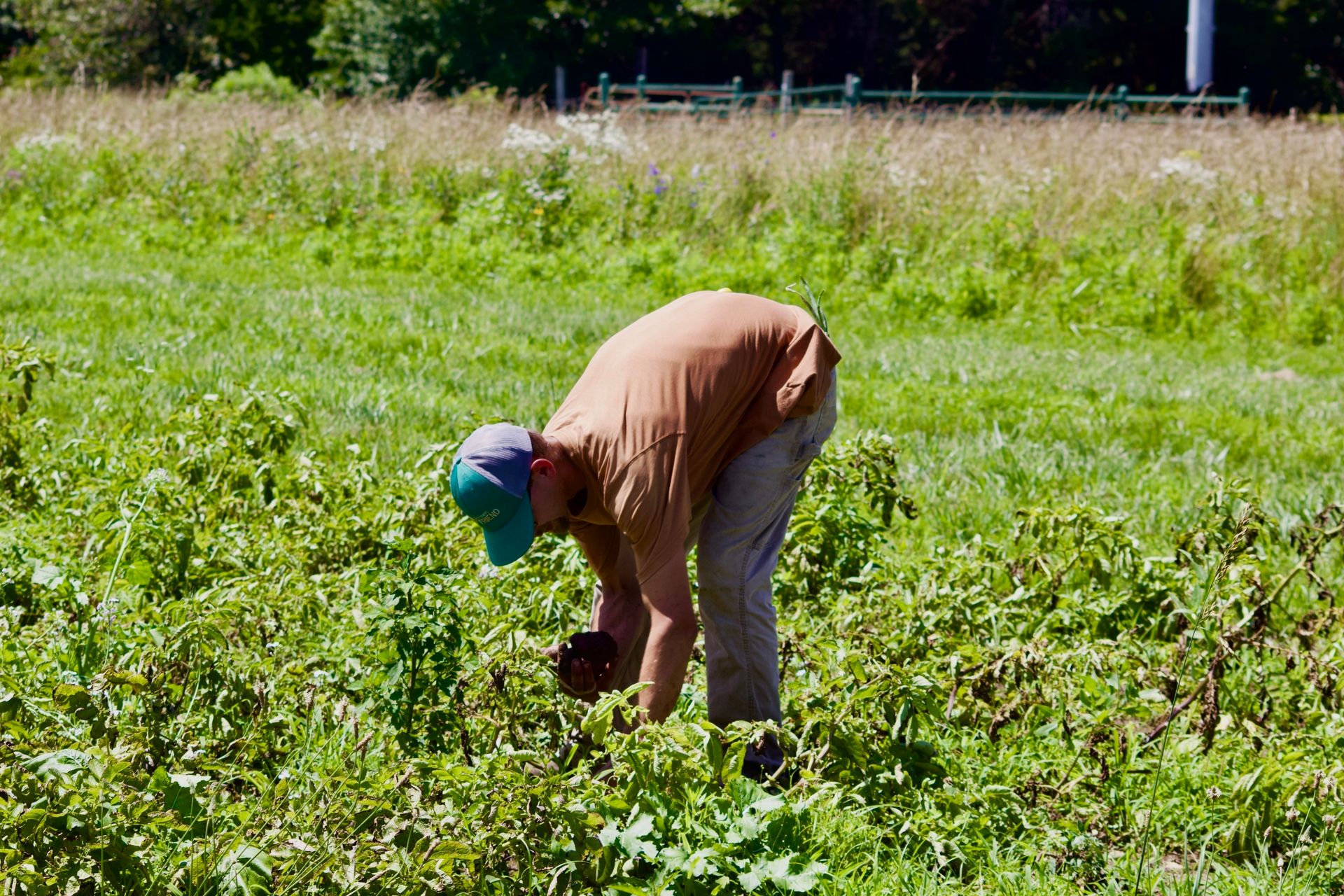
When I asked if Jeremy had ever taken a day off simply to take a break or go into town, try a new restaurant, travel, he was quick to say: “Not on purpose.”
Photo by Jessica Mathews
“This is a 25-acre headache of greenhouses and vegetables, and it has to be dealt with every day,” he says. “This isn't somebody's opinion of good living.”
But it’s his. This farm is Jeremy’s passion and obsession—the thing he takes so much pleasure and pride in. Spending time away from it would also feel like forfeiture, he says. “I feel like it could be a sacrifice either way,” he says. “I'm just really set more on this.”
‘IT MEANS A LOT MORE’
When you talk to Jeremy about it, everything led to this farm and his stand at the farmer’s market, even if it wasn’t in his head from the beginning. He always knew he wanted to do something with his hands. “I wanted to be outside,” he says. “I like physical labor.” He grins as he recalls fond moments working on the commercial farm in Illinois—of him and the other farmhands throwing watermelons down a line and into the trucks.
At the farmer’s market, Jeremy can seem shy and quiet. But just ask him about garlic, and he’ll come to life. When I went out to the farm to interview him and take pictures, we spent more than four hours walking around, as he showed me what he’s growing and his strategy behind all of it, and as he chatted up all the new investments he’s making and what he’s learning about.
It’s rare to talk with someone who is so extraordinarily passionate about one specific thing. When you find someone like that—like Jeremy—you want to hold on to their passion and excitement, to learn from it. After all, people like Jeremy know a thing or two about excellence. Not excellence for the sake of money or fame. Excellence for the sake of excellence. Because, for some, that is an end in and of itself.

Jeremy walks through the propagation greenhouse, with a vegetable he had been nibbling in his back pocket.
Photo by Jessica Mathews
Jeremy is open with me about how he hasn’t always been able to pay himself much over the last few years. Even with his mother volunteering on the farm, he’s had to spend quite a bit of the farm’s revenue investing back into the farm and the tools he needs, to buy a new well for the property, or to pay for a farmhand.
But what is “success,” really? And what does it mean to be successful? Jeremy says he feels accomplishment from the learning process—and from his customers recognizing his consistency or telling him he has an exceptional product.
“You get paid with money, but the money only goes so far. You get paid from people showing up for you, and it means a lot more,” he says.
As I left the farm, I was ignorantly sunburned and deep in reflection on those words as I drove down the windy, green roads back to my home in Bentonville. I wondered what the world would look like if we all thought about success the way Jeremy Baranauskas does. And I asked myself: is there something inside all of us waiting for the kind of attention and nurturing that Jeremy has given his farm? I’ll put it simply: I’ve never met someone who cares so much about vegetables.
Where to find Jeremy and his vegetables:
-Saturday mornings at the Bentonville Farmer’s Market or, during the off-season, Saturday pickup downtown
-Weekly at the farm, 22185 Sulfur Springs Rd., Sulfur Springs, AR
-At the Fayetteville Co-Op
-Restaurants Ryn, Conifer, Danger Dave's, and Prelude Breakfast Bar
-Instagram here
Reply